
Top Skills Every Professional Concrete Curb Finisher Needs to Master
May 07, 2026
Top Skills Every Professional Concrete Curb Finisher Needs to Master
Concrete finishing is a highly specialized trade that requires a blend of physical endurance, technical expertise, and precise timing. A professional concrete curb finisher does much more than simply pour concrete.. When it comes to curb installation and finishing, skilled crews do far more than place concrete — they shape, edge, smooth, and finish curbs to meet exact grade, drainage, and durability requirements. Properly finished curbing is essential for roadway performance, water management, site safety, and the overall appearance of a project.
If you are looking to advance in this field or simply want to understand the demands of the trade, you need to know exactly which abilities set the experts apart from the amateurs. Developing the right concrete curb finishing skills helps ensure every project meets demanding engineering specifications, drainage requirements, and municipal construction standards.
Schlouch Incorporated breaks down the essential technical abilities, safety knowledge, and soft skills required to succeed in the industry. At Schlouch Incorporated, we know the critical role skilled curb finishers play in successful civil construction projects. Below, we break down the technical expertise, safety knowledge, and professional skills required to succeed in the curb finishing industry.
Essential Technical Skills for Concrete Curb Finishing
Mastering the placement and finishing of concrete curbing is the foundation of the trade. These hard skills impact the final quality, durability, drainage performance and appearance of the finished curb.
1. Curb Placement and Finishing Techniques
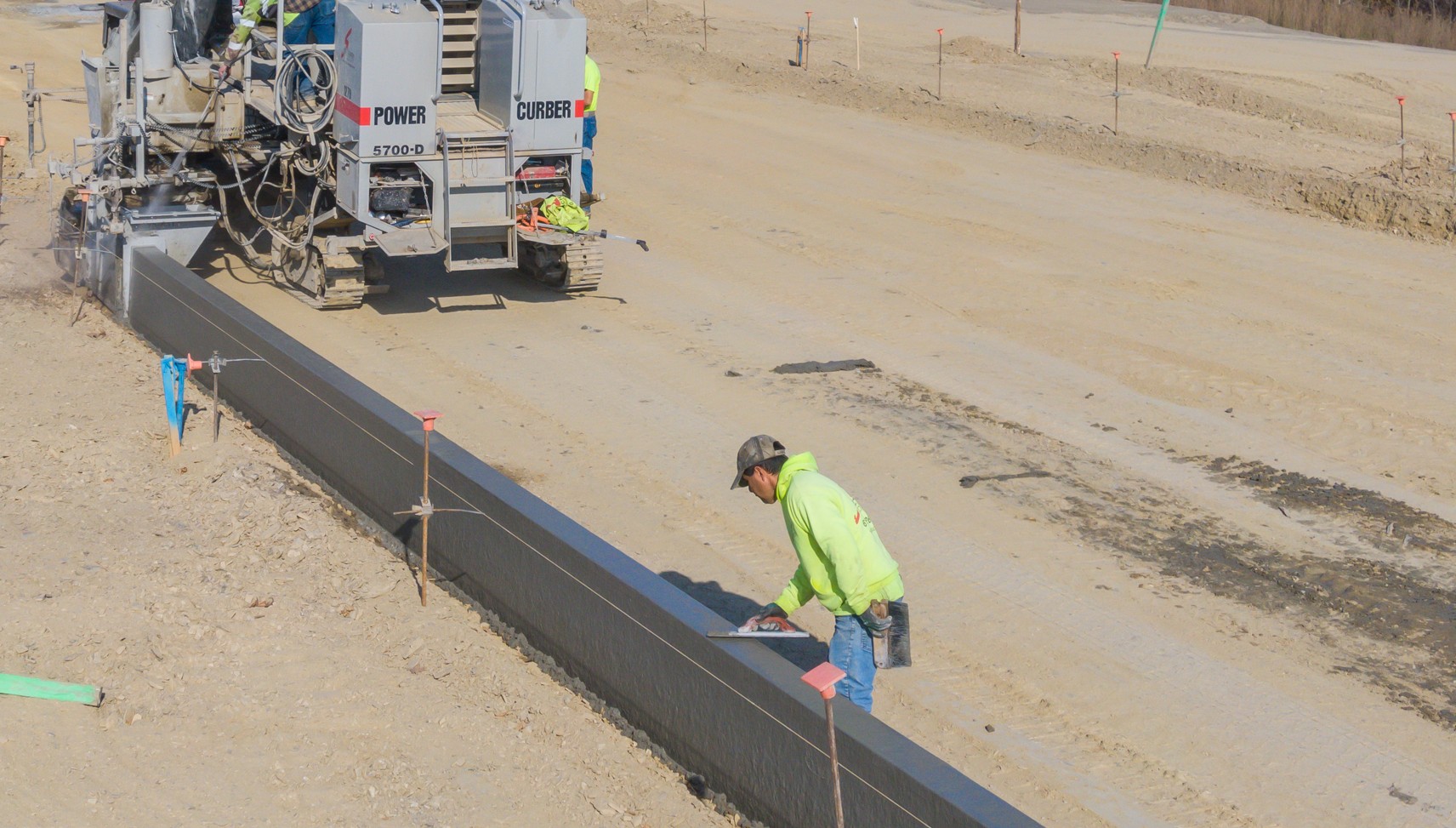
A professional curb finisher must be highly skilled in placing, shaping, and finishing concrete curbs as the material moves through the curb machine or forms. Unlike flatwork, curb finishing requires maintaining consistent curb height, radius, slope, and edge detail throughout the pour. It is important that the finishers maintain proper consistency and finish quality during continuous machine curb pours. Finishers will also use hand tools such as curb trowels, edgers, jointers, and margin tools to refine the surface and create clean, uniform lines.
2. Grade Control and Alignment
Before detailed finishing begins, curb crews must ensure the curb line follows the correct elevation and alignment. Curb finishers regularly work from string lines, site grades, and layout stakes to maintain smooth transitions, proper drainage flow, and consistent reveal heights. Once the stringline is installed, proper excavation and subgrade preparation become critical success factors, ensuring the curb machine or forms stay on grade and the finished curb meets exact project specifications. Precision during this phase is critical for preventing drainage issues, ponding water, or uneven curb appearance throughout the project.
3. Timing the Concrete Pour
Concrete waits for no one. One of the most critical skills for concrete curb finishing is knowing exactly when to float, edge, or finish the concrete surface. Finishers must constantly evaluate the curing rate of the concrete, weather conditions such as wind, humidity or temperature exposure which directly affect workability. This curing rate fluctuates wildly based on humidity, wind, temperature, and sun exposure. Finishing too early can damage curb edges and weaken the surface, while waiting too long makes it difficult to achieve a smooth, uniform finish.
4. Curb Jointing and Surface Finishing
Not all curbs require the same finish. Concrete curb finishers must understand how to create clean expansion joints, control joints, and specific finishes based on municipal specifications and project requirements. This may include brushing the curb face for texture, shaping decorative curb profiles, or finishing ADA-compliant curb transitions and ramps. Consistent joint spacing and clean edge work are essential for both appearance and long-term performance.
5. Formwork and Site Preparation
Quality concrete work starts before the trucks arrive. Finishers must know how to properly set, align, and brace the wooden or metal forms that hold the wet concrete in place. This preparation also involves inspecting the subgrade to ensure it is properly compacted and graded, preventing future cracking or settling of the slab.
Formwork, Site Preparation, and Machine Coordination
Quality curb work starts long before the concrete arrives. Excavation crews must understand how to properly prepare the subgrade for the curb machine to operate successfully. Inconsistent grading can lead to poor concrete yield and poor quality curb product creating unneccessary rework and stress for the crews. Concrete curb finishers need to verify elevations, stringline quality and any potential obstacles in their pour. If hand set curb is required, crews must know how to set up forms and align them to maintain straight, uniform curb lines throughout the pour.
6. Joint Cutting and Defect Repair
Concrete naturally shrinks as it dries, which leads to cracking. A professional concrete curb finisher controls this process by sawing expansion and contraction joints at precise intervals, forcing the concrete to crack in neat, hidden lines.
Additionally, they must possess the skills to patch and repair minor surface defects that may occur during the curing process.
Essential Knowledge and Safety Practices
Beyond the physical tools, a professional concrete curb finisher must possess a deep understanding of the materials they work with and the safety regulations that govern the job site.
Material Knowledge
Concrete is a complex chemical mixture. Finishers must understand different concrete mixes, water-to-cement ratios, and how various aggregates affect the final product. Knowledge of slump, water-to-cement ratios, aggregate size, and mix consistency is especially important in curb work, where concrete must maintain its shape as it moves through slipform machines or forms. Furthermore, they need to know when and how to use specific chemical additives, accelerators, retarders, and curing agents to manipulate the drying time and improve strength.
Safety Compliance and Equipment Operation
Civil construction sites present numerous hazards. During curb installation operations. Concrete curb finishers regularly work around slipform curb machines, excavators, skid loaders, dump trucks, compactors, and concrete delivery equipment, making safety awareness critical at all times. A professional concrete finisher must follow Schlouch’s safety policies as well as Occupational Safety and Health Administration (OSHA) standards to protect themselves and their crew members from injury.
Reading Blueprints and Specifications
Every successful pour relies on accurate planning and layout. Curb finishers must be able to read civil construction drawings, grading plans, utility layouts, and engineering specifications to understand curb elevations, drainage flow, radiuses, and tie-in locations. Finishers must be able to interpret civil site drawings, And Reading blueprints to fully understand the project specifications for the curb product.
Key Soft Skills for the Job
Technical know-how is only part of the equation. To truly excel, concrete workers must cultivate specific soft skills that allow them to handle the rigorous demands of the construction industry.
1. Physical Stamina
Concrete curb finishing is incredibly demanding work. Professionals must possess the physical stamina to lift heavy materials, kneel for hours at a time, and perform repetitive motions. They also spend extended periods working outdoors in extreme heat, cold, and varying weather conditions.
2. Attention to Detail
Small inconsistencies in curb alignment, joint spacing, or finish quality can create major issues for drainage, roadway appearance, and inspection approvals. Attention to detail ensures curbs maintain smooth lines, proper elevations, clean edges, and consistent transitions throughout the project. Skilled curb finishers understand that precision directly impacts both functionality and long-term durability.
3. Teamwork and Communication9. Teamwork and Communication
No curb installation project succeeds without coordination and teamwork. Successful curb finishers constantly communicate with curb machine operators, laborers, grade crews, survey teams, truck drivers, and site supervisors throughout the pour. Strong communication helps crews maintain production flow, quickly address grade changes or site obstacles, and safely coordinate work around other trades operating nearby.
4. Problem-Solving on the Job Site
Unpredictable issues arise on almost every pour. Whether it is a sudden rainstorm, equipment failure, or a rapidly drying curb product due to high winds, professionals must adapt quickly. Problem-solving skills allow curb finishers to adjust their techniques on the fly to overcome concrete technical challenges and environmental changes.
Build a Solid Career with Schlouch IncorporatedBuild a Solid Career with Schlouch Incorporated
Mastering these techniques takes time, dedication, and hands-on experience. The best curb installations are completed by skilled professionals who understand concrete behavior, site grading, machine coordination, and the precision required to maintain clean lines and proper drainage throughout a project. By mastering placement techniques, blueprint reading, and problem-solving, a professional concrete curb finisher guarantees a durable and high-quality result for any construction project.
At Schlouch Incorporated, we pride ourselves on delivering exceptional site design and construction services, and we know that our success is built on the expertise of our team. If you are a professional concrete curb finisher looking to apply your skills in a dynamic, safety-focused, and rewarding environment, we want to hear from you.
Bring your expertise to a company that values hard work and precision. Apply at Schlouch Incorporated today to take the next step in your construction career.